

Miami's Urban Core is Rewritten by Capital
by Alex & Joe - Updated March 2026
Downtown Miami has often been described as “in transition” but in 2026 that phrase is outdated. Downtown is being intentionally reconstructed around infrastructure, transit, and global capital. If Brickell is Miami’s financial engine, Downtown and Park West are its long-term urban experiment. The question isn’t whether it’s changing, it's if you want to live in and be a part of that change. (read more)
Downtown Miami Condos For Sale
Live Listings: Current condo availability in Downtown, updated every 15 minutes from the Miami MLS. Call or text Alex at 305.712.6522 to schedule your private tour of any condo you see here or to ask any questions about Downtown Miami or high-rise condo living.


Condo Living in Downtown Miami
Buyers we work with often think at first that Downtown is one single area. In reality, there are two very different neighborhoods within Downtown - Historic Downtown and Park West. Let's discuss those first.
Historic Downtown
This is the older core of downtown, made up mostly of government buildings, offices and older legacy condo buildings. Some condo buildings here predate Miami’s luxury evolution and you can see it in the earlier development standards. There is a lot to choose from here and there are good values to be had.
Park West / Miami WorldCenter
This is where the future is being built. Miami WorldCenter spans over 27 acres and represents one of the largest urban mixed-use developments in the United States. Signature towers here include:
Retail anchors, hospitality, and Brightline’s central station all sit within walking distance. Park West feels newer with curated landscaping and a logical street grid. This is Miami finding a way to create a cohesive urban identity for downtown.
Let's spend a minute on the Brightline station, which we think is one of Downtown's most underestimated assets currently with big potential in the near future. The station offers direct rail access to Fort Lauderdale, West Palm Beach, Orlando and soon it will go to Tampa. For professionals who travel frequently within Florida this is huge. But more than that, adding transit-oriented development has historically driven appreciation in major U.S. cities, and we think Miami is no exception.
Shift to Full-Time Residents
Downtown has historically been investor-heavy and rather transient. For years, many towers were built with rental flexibility in mind which created liquidity but not exactly the kind of luxury we're becoming used to. Like in Edgewater, that changed with Covid and towers built in 2020 or later shifted upward in quality and luxury.
Developers began targeting full-time residents rather than short-term investors. Simultaneously, institutional capital poured into multifamily towers which is a great sign of confidence. In some cases now you’ll find two or three rental buildings for every new condo tower.
Pricing in Downtown varies dramatically by building age. Older inventory is often priced below Midtown or Brickell on a per-square-foot basis. However the signature luxury towers command significant premiums. Buildings like 1000 Museum exist in an entirely different category than early-2000s investor towers. The mistake buyers make is assuming “Downtown pricing” is a single number. It isn’t. It’s building-specific.
Is Living in Downtown Miami Right For You?
This is a much bigger question than we can answer here without knowing you. But here are some high-level things to think about and questions to ask yourself to help get you started. Contact us anytime to discuss your current situation and we can help walk you through a more detailed approach to deciding about living in Downtown.
Downtown residents have told us they love having so much extended waterfront walking. You can walk one way and get to Brickell or the other way toward Edgewater all along Biscayne Bay. And since our natural anchor is water your view would change daily. Of course like everything this can be a blessing and a curse, as there is a LOT of foot traffic in downtown from residents, tourists and businesspeople alike. This is not a quiet, residential district and all those elements co-exist here.
We find Downtown appeals more to buyers who recognize Miami as the emerging global tier-one city rather than a resort market. Forget nostalgia - this place is all about trajectory now. People who do well here are those who believe in the long-term urban expansion that's happening and who appreciate the signature towers and amazing architecture we have now. Obviously if you work Downtown you're going to love the short commute, but with the Brightline station that could include working in Fort Lauderdale, West Palm Beach and more.
So who doesn't do well in Downtown then? Those who want the convenience of condo living in a luxury tower but also want some neighborhood charm and kid-friendly infrastructure probably aren't going to like the vibe here. It's high-density dynamic living so if you want a slower pace where you meet your neighbors walking down the street there are better options. We can help you find them.
Notable Downtown Miami Buildings
Downtown Miami has more condo towers than most buyers realize, spanning everything from early-2000s investor-era buildings to some of the most architecturally significant residential towers in the United States. These are the buildings we show most often. Each represents a distinct tier of the market, and we would be happy to help you understand which one fits your goals.
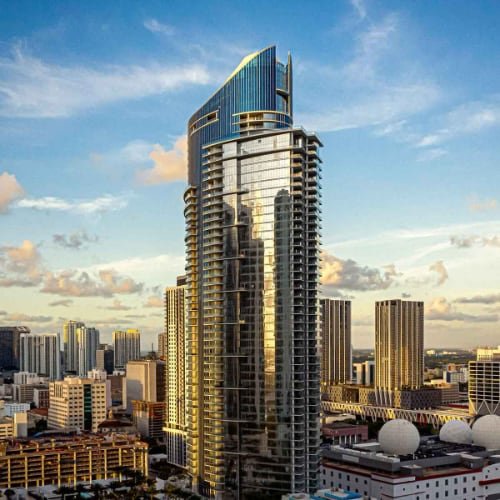 Paramount WorldCenter — 58 stories • 569 units • Completed 2019
The anchor residential tower of the 27-acre Miami WorldCenter master plan. Developed by Daniel Kodsi's Royal Palm Companies and designed by Elkus Manfredi Architects, Paramount was one of the first buildings to establish Park West as a serious residential destination. The six-acre amenity deck is one of the most expansive in Miami and includes resort pools, tennis courts, a basketball half-court, a soccer field, a boxing studio, a jam room with a recording studio, and a rooftop observatory. Units feature 10-foot ceilings, private elevators, and deep terraces. Pricing is more accessible than the branded towers, which makes Paramount a strong option for buyers who want modern construction and massive amenities without spending $3M+ to get in the door.
1000 Museum — 62 stories • 84 units • Completed 2019
This is the building that put Downtown Miami on the global architecture map. Designed by the late Pritzker Prize-winning architect Zaha Hadid, 1000 Museum features a concrete exoskeleton composed of 5,000 pieces of glass-fiber-reinforced concrete. That structural system has never been used at this scale before. With only 84 residences, it is one of the most exclusive addresses in Miami. Half-floor units start at roughly 4,600 square feet, and full-floor penthouses exceed 9,900 square feet. Amenities include a rooftop helipad, an indoor aquatic center, a sky lounge, and a private vault for storing art and valuables. This building exists in an entirely different category from every other tower in Downtown. If you're looking for a museum-quality residence on Biscayne Boulevard, this is it.
Aston Martin Residences — 66 stories • 391 units • Completed 2024
At 817 feet, Aston Martin Residences is the tallest all-residential building south of New York City. Developed by G&G Business Developments and designed by Revuelta Architecture with Bodas-Miani-Anger, the sail-shaped silhouette has become one of the most recognizable profiles on the Miami skyline. The building sits at the mouth of the Miami River with direct Biscayne Bay frontage and a superyacht marina. Interiors throughout the common areas were designed by Aston Martin's own team. Sky amenities span four floors. Residences range from one-bedroom units to the headline triplex penthouse, which was listed at $59 million and includes the last Aston Martin Vulcan ever produced. The building was 99% sold before opening. Resale activity is now underway, and pricing reflects serious demand.
Waldorf Astoria Hotel & Residences — 100 stories • 387 residences • Under construction (est. 2028)
When complete, this will not only be the tallest building in Miami, it will be the tallest in the entire southeastern United States at 1,049 feet . This will be Miami's first true supertall skyscraper. Developed by PMG and Greybrook Realty Partners, the tower was conceptually designed by Carlos Ott and executed by Sieger Suarez Architects. Its signature design of nine stacked, offset glass cubes will be unlike anything else on the skyline. The tower will combine 387 private condominiums with a 205-key Waldorf Astoria hotel. Interiors by BAMO. Every residence is fully finished and furnished with 10-foot ceilings and floor-to-ceiling glass. The project is over 90% sold with limited availability remaining. If you are drawn to trophy properties with global brand cachet, this is the most significant one under construction in Miami right now.
Ten Museum Park — 50 stories • 200 units • Completed 2007
One of Downtown's earlier luxury towers, designed by award-winning Miami architect Chad Oppenheim with his signature clean, minimalist aesthetic. This building offers some of the best waterfront views in Miami, and it's located directly across from Maurice A. Ferré Park (formerly Museum Park) which is home to the Pérez Art Museum Miami (PAMM) and the Frost Museum of Science. The loft-style residences with 10- and 20-foot ceilings have a character that's hard to find in newer towers. At 200 units, it's more boutique than most Downtown buildings, and the Clinique La Prairie-powered wellness center adds a level of amenity that still holds up. Pricing here is significantly below the new-construction towers, making it an interesting value play for buyers who want an established, architecturally distinctive building on Biscayne Boulevard.
Downtown Miami Condo FAQ
Common questions we hear from buyers exploring Downtown Miami, answered by Alex & Joe of The Alex + Joe Team at Compass.
Downtown works well for a specific kind of buyer: someone who sees Miami as an emerging global city and wants to be in the middle of its most ambitious development cycle. The infrastructure is real. Brightline's central station connects you by rail to Fort Lauderdale, West Palm Beach, and Orlando. Miami WorldCenter is delivering retail, hotel, and residential density at a scale Downtown has never had. Museum Park, the Pérez Art Museum, the Frost Museum of Science, and the Adrienne Arsht Center are all within walking distance. The trade-off is that this is still an urban core in transition, not a finished product. Street-level life is uneven. Some blocks feel fully activated, while others are still catching up. If you need a quiet, self-contained neighborhood with strong walkable retail today, Edgewater or Midtown might be a better fit. But if you're drawn to the energy of a city being built around you and can see where it's heading, Downtown is one of the most compelling places to buy in Miami. These are two distinct sub-neighborhoods within Downtown, and confusing them is a common mistake. Historic Downtown is the older core: government offices, courthouses, and legacy condo buildings, some of which predate Miami's luxury condo evolution. You can find good values here, but the building standards and amenity packages in the older towers are noticeably different from what's been built in the past decade. Park West is the newer district anchored by Miami WorldCenter. Signature towers like 1000 Museum, Aston Martin Residences, Paramount WorldCenter, and the Waldorf Astoria are all here. The streetscape is more curated, the landscaping is deliberate, and the retail infrastructure is growing rapidly. When buyers tell us they want to live in Downtown, the first question we ask is which Downtown. The answer changes everything about which buildings we show. Brickell is more finished. It has denser street-level retail, a stronger restaurant scene, established nightlife, and a professional population that gives it a consistent weekday-to-weekend rhythm. Downtown is earlier in its arc. It's bigger, rougher, and more unevenly developed, but it also has the most dramatic development pipeline in the city. The architectural ambition in Downtown right now (think 1000 Museum, Aston Martin, Waldorf Astoria) has no equivalent in Brickell. Price-per-square-foot in Downtown's older inventory is generally lower than comparable Brickell buildings, while the ultra-luxury towers command similar or higher pricing than anything in Brickell. That split is exactly why Downtown confuses people. There is no single "Downtown price." There's a building-specific price, and the range is enormous. It depends entirely on your profile. For trophy ultra-luxury, 1000 Museum is in a class by itself: 84 residences designed by Zaha Hadid with a rooftop helipad and some of the largest floor plans in the city. Aston Martin Residences just delivered and offers branded luxury at scale with a superyacht marina and panoramic river-to-bay views. The Waldorf Astoria will be the tallest tower in the Southeast when it completes and brings five-star hotel services into the residential experience. For buyers who want modern construction and strong amenities without ultra-luxury pricing, Paramount WorldCenter is the most popular choice we show. The six-acre amenity deck alone sets it apart. Ten Museum Park and Epic offer established waterfront positions at lower price points. The right building depends on whether you're buying for lifestyle, long-term appreciation, or investment income, and that's the conversation we have with every buyer. Downtown has the widest price range of any neighborhood in Miami, which is both its strength and its source of confusion. In the older Historic Downtown buildings, you can find one-bedrooms starting below $300K and two-bedrooms in the $400K to $700K range. In Park West's established towers like Paramount WorldCenter, resale two-bedrooms commonly trade in the $800K to $1.5M range. The ultra-luxury tier operates on a completely different scale: half-floor residences at 1000 Museum start around $7M, Aston Martin penthouses have sold for $25M+, and the Waldorf Astoria penthouse collection reaches $50M. Per-square-foot pricing spans from under $400 in older buildings to $2,000+ in the signature towers. Treating "Downtown pricing" as a single number is the most common mistake buyers make. Every building tells a different story, and that's why building-level analysis matters more here than in any other Miami neighborhood. We think it's one of Downtown's most underestimated assets with major upside potential. Brightline's MiamiCentral station gives Downtown direct rail access to Fort Lauderdale, West Palm Beach, Orlando, and eventually Tampa. For professionals who travel frequently within Florida, it eliminates a huge friction point. But more importantly, transit-oriented development has historically driven meaningful appreciation in major U.S. cities, and Miami is following the same pattern. The density building around the station (residential, retail, office) is creating a real urban node that didn't exist five years ago. For buyers thinking about long-term value rather than just current amenities, proximity to the Brightline station is a factor worth weighting heavily. Florida's HB 913 requires all condo associations to conduct Structural Integrity Reserve Studies and fully fund reserves for major building components. In Downtown, this is especially relevant because the neighborhood has a wide age range of buildings. The older towers, some dating to the early 2000s, are the ones to evaluate most carefully. Some have had to levy special assessments to close reserve funding gaps, and a few have seen significant HOA fee increases as they come into compliance. The newer signature towers like Aston Martin and Paramount WorldCenter were built under more stringent codes and generally started with stronger reserve positions. We always review the reserve study, recent special assessments, and board meeting minutes for any building a buyer is considering. In a neighborhood with this much building-to-building variation, reserve health is one of the first things we look at. The pipeline is enormous. The Waldorf Astoria is the headline project, a 100-story supertall that will be the tallest building in the Southeast when it delivers in 2028. Beyond that, the Miami WorldCenter master plan continues to add towers across its 27-acre footprint. Multiple condo, condo-hotel, and multifamily projects are in various stages of approval and construction throughout Park West and the broader Downtown core. The effect of this pipeline is transformational. It's adding thousands of residential units, hundreds of thousands of square feet of retail, and hotel inventory that didn't exist before. For current owners, the new supply brings better neighborhood infrastructure but also competition. For buyers, it means real optionality between established resale product and brand-new branded towers. We keep close track of the pipeline and can help you understand how each new project affects the building you're considering.Is Downtown Miami a good place to live?
What is the difference between Historic Downtown and Park West?
How does Downtown Miami compare to Brickell?
What are the best condo buildings in Downtown Miami?
What is the price range for condos in Downtown Miami?
How important is the Brightline station for Downtown real estate?
What should I know about Florida's HB 913 and structural reserves in Downtown?
What new development is coming to Downtown Miami?

Contact Alex & Joe about Downtown Miami Condos
See every condo in every Miami building.
We have the Miami - Dade condo market covered.
Our site updates every 15 minutes throughout the day to bring you the latest condo listings.